
Tactics and strategy are both central to a business, particularly in its early stages or a period of reset. But for as different as they are, they’re highly codependent. And while many novice tacticians struggle to develop strategic instincts, senior leaders repeatedly undervalue the tactical pillars of their team’s strategy.
Here’s a personal overview of the two, how they differ, and how they critically relate.
The difference between tactics and strategy
In the simplest terms: Strategy is where you want to go, and tactics are how you get there.
In practice, your strategy is the sum of a problem or opportunity, the strategic initiative(s) you pick to solve it, and the sequence of tactics you use to execute on that initiative. You might have five tactics, but they should all map back to at least one strategic initiative, which ultimately serves a single opportunity. The key piece of this definition is that while tactics drive your strategy’s progress, the strategic initiative determines which tactics you choose to begin with, and the order in which you prioritize them. Hence their codependence; you can’t have one without the other.
Example of strategy and tactics working together
Let’s say you own a local pet supply shop, and you’re doing so well that you want to start selling to a broader geography. That’s your opportunity. There are a few paths you can take to make that happen: You can open new locations, franchise your business, or launch an online store. Those are your strategic initiatives.
For the sake of example (and keeping with my area of expertise), let’s assume you decide to go online. To do that, you need, among other things:
- Domain hosting or an account on a third-party marketplace (Etsy, Chewy, eBay, etc.)
- E-commerce software (content management, point-of-sale, payment, etc.)
- A shipping model (dropshipping, in-house fulfillment, third party, etc.)
- A well-researched mix of marketing channels (SEO, social media, affiliates, etc.)
- Scalable supply chain to support order volume
- Specialists to fill gaps in your skillset across these things
Those are your tactics, and as you can tell, they’re specific to the launch of an online store; things would look tactically different if you picked another strategic initiative. Together, your chosen expansion method, and supporting investments, are your strategy for selling to a broader geography.
It’s also worth noting strategies may be hierarchical, per the flowchart below. As they mature, the success of certain tactics merits the creation of their own strategies — like a dedicated SEO strategy.

The problem with mistaking tactics for strategy
To state what’s obvious to every executive, tactics are not inherently strategic. Without a proven problem or opportunity to guide you, any tactic you invest in is arbitrary and risks lacking the support of related tactics that work toward the same goal. To quote a CEO I once worked with, tactics by themselves are “just a bunch of stuff you want to do.”
Another way to look at it is that tactics cannot be mistaken for strategy because tactics are the result of a strategic initiative, and the initiative comes first. Consider our pet supply example from earlier: Building a website, leasing a second space across town, and writing a franchise agreement are three tactics that, ostensibly, can help you expand your business. But they’re all fundamentally different ways of doing that, and each one would likely fail because the other two aren’t designed to help it succeed. They each map back to a different strategic initiative.
Now take another look at the tactics involved in opening an online store: Building your website is one thing, but proper marketing attracts visitors to that site. Carefully integrating point-of-sale and payment tools creates a good purchase experience once they find you, and you can’t fulfill their orders without an efficient shipping model. Every tactic complements the one next to it because they all come from the same strategic initiative.
Why AI often overvalues tactics
The big question: Can AI create an effective strategy for you? Let’s ask.
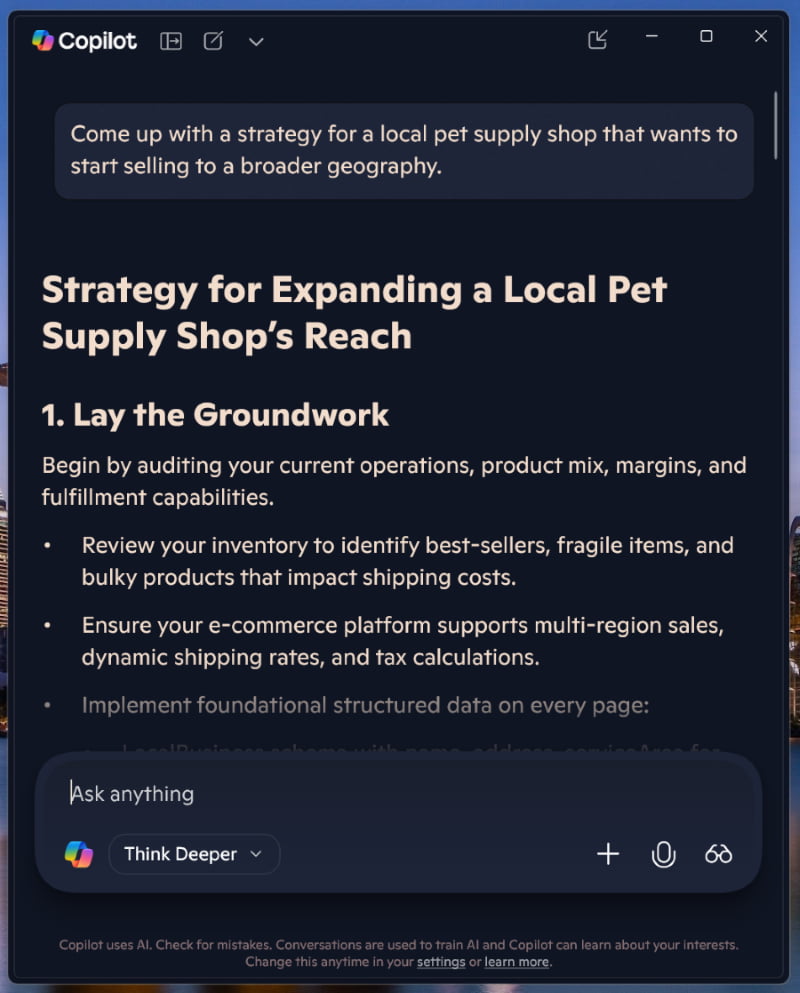
I set it to “Think Deeper” since I’m expecting a meatier answer, and to its credit, Copilot went in-depth. Here’s a bulleted summary of its response:
- Lay the groundwork
- Build a scalable shipping & fulfillment framework
- Activate multichannel sales
- Drive discovery with SEO & content
- Amplify reach with paid campaigns
- Cultivate partnerships & community connections
This is comprehensive, but it’s still hard to see a tailored strategy in here. At best, these are six strategic initiatives I could invest in separately and would require their own strategies to pull off.
I love the first step of Copilot’s plan, where I audit my current product mix to determine how best to scale each part of my inventory. But it quickly splinters in several directions and skips some decision-making I’d normally go through first: Item #2 implies I’ve agreed to accept online orders, which is not necessarily true. Item #3 does the same thing, while item #4 doesn’t totally apply to me if I’m using a third-party marketplace (and not every storeowner knows that). Item #6 is great if I’ve already identified and opened in new local communities, but I don’t see any guidance for how to pick and pursue the right ones.
Granted I’m using Microsoft’s AI assistant, and other LLMs might respond differently. Suffice it to say, though, AI has a proclivity to recommend tactics over strategy for a couple of reasons…
First, LLMs generally cite the most mentioned topics (like e-commerce and SEO) that are semantically aligned with your query, and there’s a lot more tactical-level content online grounding LLMs’ answers. It’s perhaps inevitable that AI jumps right to this altitude without more guidance upfront, which brings me to the second reason it delivers tactics prematurely: AI demands specificity, and my original prompt was anything but specific. If I want AI to generate a truly personalized strategy, I need to answer more initial questions for myself. Then, I can fill out the original prompt with these conditions, like what my budget is, what I’m already doing, where I sell currently, what I tried that didn’t work, and what strategic pivots I might be interested in making.
In my opinion, AI performs best when it’s helping prioritize and advise on the tactics that support a predetermined initiative. And if you do want it to help you develop strategy, more detail is better. Just be sure to weigh the cost of sufficiently briefing an LLM on your business with what you’re getting in return. In many cases, including SEO, AI-led strategy is kind of a catch-22: To “generate” an effective one, the prompt should imply you know enough about the subject that you might be better off crafting it yourself — or hire the right human (like me) to help you write it, sequence it, and manage it post-launch.
The problem with mistaking strategy for tactics
Now, despite the importance of strategic thinking at a project’s inception, tactical thinking is unfairly stigmatized in business as it can reveal an inability to make smart decisions at a higher altitude. But just because someone has lots of specific ideas or experiments in mind (their tactics) doesn’t mean they can’t see the forest for the trees. Unfortunately, too many executives treat this as a red flag when looking to fill leadership roles in their company; as soon as you get even a little in the weeds, the underlying strategy disappears. This is trouble for both parties:
For a strategist, this misconception can make career growth a self-confidence roller coaster as you meet folks who have varying levels of bias for/against your thought process. Over the years, I’ve presented strategies of a similar format to numerous marketing executives: One said it was the best and most organized SEO strategy they’d ever seen. Another said it was devoid of any actual strategy at all. Go figure. The point is, don’t fixate on what high-ranking colleagues think of your work. Whether they’re an associate or the CMO, they’re just a big bag of changeable opinions like everyone else. They may be more exposed, but that doesn’t make them more informed. The truth lies between them somewhere, and it’s up to you to accept feedback where you feel it’s most constructive.
For a senior leader, over-indexing on strategy can cause you to sit on underperforming programs for years while dismissing folks who have excellent solutions to offer because they don’t just look at problems from 30,000 feet. Or, more commonly, you defund these programs altogether because they didn’t do exactly what you wanted, assuming there must be a macro-level reason for the failure. “We need a new strategy.” Your strategy is fine — check your tactics.
Issues with overvaluing strategy
Here’s a real story from a different SEO vendor, though sadly I don’t have their original case study anymore:
- Right before the pandemic, a large company reported their organic traffic was in freefall, and given the amount of revenue at stake, offered a marketing agency over $1 million to create a new SEO strategy that would restore their visibility in search results. (It should go without saying, but I generally don’t charge as much as a building contractor for SEO services.) However, within a week of signing a contract, the agency discovered their client was accidentally blocking Google’s access to most of their website in a single root-level file. Fixing this file is usually trivial, and following early signs of recovery, the agency kindly offered to renegotiate the cost of their partnership.
It’s an extreme example, to be sure, but these oversights happen more often than you think, and it puts a sobering price on mistaking a tactical problem for a strategic one. Big failures don’t automatically require “big picture” solutions, and this business almost paid a seven-figure penalty for thinking they do.
In place of a source for that story, consider Steve Jobs, who, while himself polarizing, shares an experience that corroborates my point:
The “professional management” Jobs refers to in the interview above typically retreat to strategy in the absence of tradecraft. And sometimes that’s a good thing; corporations have huge teams of tacticians who need someone to spend time aligning vectors and ensuring everyone stays focused on the same thing. But even then, it’s hard to do that well if you don’t have some firsthand familiarity with the stuff your team does all day.
Strategy vs. tactics in small companies
In my last journal entry, I mentioned that startups typically need more tradecraft in leadership seats, and you can gradually introduce traditional management as headcount grows. This is a good example of where it’s important to be crisp on the difference between tactics and strategy, but also to not see them as mutually exclusive.
If you’re hiring a director, VP, or even an agency partner, don’t turn your nose up at candidates who spend a non-trivial amount of time talking about the mechanics of their work. Listen carefully for rationale, sequencing, and general consistency in how everything they recommend addresses a shared problem or opportunity. Good tactics are built on sound strategy, but focusing only on the latter is like planning a road trip with no car. Knowing where you want to go, and even the most efficient way there, means nothing without a physical way to travel it. And in a candidate who, according to one learned executive, doesn’t “know how to do anything,” you might just be hiring an empty promise.
Strategy vs. tactics in large companies
When I was in high school, I joined the cross country team and spent the first run of the season just trying to keep up like the other freshmen. And despite being strung out the length of a football field, our coach jogged back along the road to every one of us, yo-yoing his pace back and forth to make sure we were alright, maintained our form, and knew where to turn when we lost sight of the leaders. Three years later, I was doing the same thing for the younger class.
You would never hire a coach who couldn’t do this (not with freshmen, anyway), so why should business be any different?
If you’re a larger company, with the right tacticians already in-house, leaning strategist in your new department head is more appropriate as long as they can handle the complexities that emerge within their team. Hierarchies work best when the boss can comfortably visit and collaborate with folks at each rung. Nobody, regardless of business size or stage, is too senior to get their hands dirty.
 Braden Becker
Leave a comment